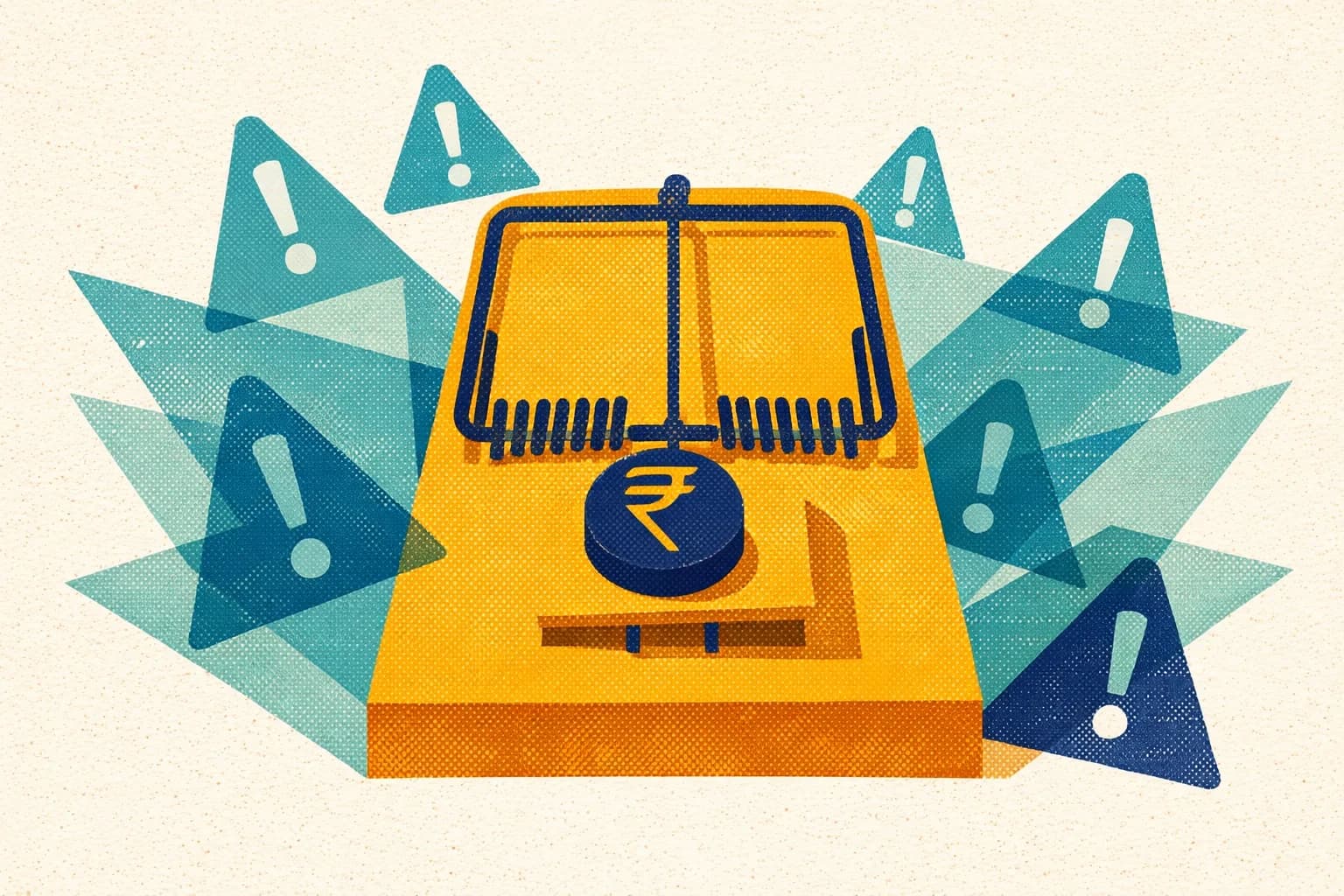

Joint term insurance sounds appealing on paper: one policy, two lives covered, lower premium than buying separate plans. Insurers market these plans as the smart choice for modern couples. But is the convenience worth the trade-offs?
The answer depends entirely on how the policy is structured, what happens after the first claim, and whether both partners actually need the same level of coverage. This article breaks down joint term insurance honestly, so you can decide whether it works for your family or whether two separate policies make more sense.
Cheat sheet
98.32%
Industry claim settlement ratio (by count)
FY 2024-25
—98.36% in FY 2023-24
₹33,697 cr
Total individual death claims paid
FY 2024-25
▲+16.7% from ₹28,868 cr in FY 2023-24
- Joint term insurance covers two lives under one policy, typically paying out on the first death
- Premiums are 10-20% lower than buying two individual policies of the same value
- The biggest drawback: after the first death payout, the surviving spouse often loses coverage entirely
- Separate policies give each partner independent, customizable coverage that does not terminate after one claim
- Joint plans work best for dual-income couples with similar coverage needs and no complex financial situations
How Joint Term Insurance Works
A joint term insurance policy covers two people (usually spouses) under a single plan. Here is the typical structure:
- Both lives insured: If either partner dies during the policy term, the sum assured is paid to the surviving spouse
- Single premium: One combined premium for both, usually lower than two separate policies
- First-death payout: Most joint plans pay out only once (on the first death) and then the policy ends
- Some plans offer second-death payout: A few insurers offer coverage until both partners have passed, but these plans are more expensive and less common
Joint Term Insurance: The Pros
1. Lower Combined Premium
The most marketed benefit. A joint plan for Rs 1 crore cover typically costs 10-20% less than two separate Rs 1 crore policies. For a couple in their early 30s, this could mean saving Rs 2,000-4,000 per year.
2. Simplified Administration
One policy number, one premium due date, one renewal cycle. For couples who want minimal paperwork, this is genuinely convenient.
3. Tax Benefits on Premium
Premiums paid towards a joint term insurance policy qualify for deduction under Section 80C of the Income Tax Act (available only under the old tax regime), up to Rs 1.5 lakh per year. Both partners can claim the deduction if they share the premium payment.
Key Fact
Section 80C premium deductions apply only under the old tax regime. If you’ve switched to the new tax regime, you won’t get any deduction on your term insurance premium — joint or individual.
4. Waiver of Premium Benefit
Some joint plans include a built-in waiver: if one partner dies, future premiums are waived for the surviving spouse, and coverage continues until the policy term ends. This is a meaningful benefit, but only if the specific plan includes it.
Joint Term Insurance: The Drawbacks
1. Coverage Ends After the First Death (Usually)
This is the critical flaw. In most joint first-death plans, after the payout is made, the surviving spouse has zero coverage. If they want insurance after that, they must apply fresh at an older age, potentially with health issues, and at a much higher premium.
Watch Out
Most joint term plans pay out only once. After that payout, the surviving spouse has no coverage and must buy fresh insurance at an older age — when premiums are higher and health conditions may trigger exclusions or loading.
Consider: a 35-year-old woman who loses her husband under a joint plan now needs to buy individual term insurance at 35 or 40. If she has developed any health conditions in the meantime, she may face exclusions, loading (higher premium), or outright rejection.
Industry life insurance death claims intimated (count): FY 2019-20 to FY 2024-25
2019-20
8,73,832
2020-21
10,95,113
2021-22
16,05,869
2022-23
10,74,546
2024-25
10,33,997
Source: IRDAI Annual Reports, 2019-20 to 2024-25. Death claims nearly doubled during the pandemic years. In a joint first-death plan, the surviving spouse would have lost coverage right when mortality risk was at its peak.
2. Coverage Amounts Cannot Be Customized Per Person
In a joint plan, both partners share the same sum assured. But in reality, their financial contributions and coverage needs are often very different.
Example: If the husband earns Rs 20 lakh annually and the wife earns Rs 8 lakh, the husband might need Rs 1.5 crore cover while the wife needs Rs 50 lakh. A joint plan forces a single cover amount, leading to either over-insurance for one or under-insurance for the other.
3. Smoker Penalty Affects Both
If one partner is a smoker or tobacco user, the joint policy premium reflects the higher-risk profile. With separate policies, only the smoker pays the elevated premium while the non-smoker gets standard rates.
Did You Know
A single smoker in a joint policy raises the premium for both partners. With two separate policies, only the smoker pays elevated rates — the healthy partner gets standard pricing.
4. Divorce Complications
Joint term insurance policies generally cannot be split into two individual policies. In the event of divorce, the couple faces a messy situation: who keeps the policy? Who continues paying the premium? Most often, the policy gets surrendered (with zero value, since it is term insurance) and both partners must start fresh.
Joint vs Separate Policies: Side-by-Side Comparison
| Factor | Joint Term Plan | Two Separate Policies |
|---|---|---|
| Annual premium (Rs 1 Cr cover, both age 30) | Rs 14,000-16,000 | Rs 17,000-20,000 |
| Coverage after first death | Ends (most plans) | Surviving spouse still covered |
| Customizable cover per person | No (shared amount) | Yes (independent amounts) |
| Smoker impact | Affects both | Only the smoker |
| Policy management | 1 policy | 2 policies |
| Divorce scenario | Policy typically surrendered | Each keeps their own |
| Rider flexibility | Limited | Full (each chooses own riders) |
| Tax deduction | Section 80C (shared) | Section 80C (each can claim up to Rs 1.5L) |
When Joint Term Insurance Makes Sense
- Both partners earn similar incomes and need roughly the same level of coverage
- The plan includes a premium waiver that continues coverage for the surviving spouse
- Budget is tight and the 10-20% premium savings matters
- Both are non-smokers with similar health profiles
- The couple has no children and the primary goal is to protect each other (not fund future education or other long-term goals)
When Separate Policies Are Better
17,333
Individual death claims repudiated across the industry in FY 2024-25, worth ₹976 crore. If a joint plan terminates after the first death and the surviving spouse must reapply at an older age or with new health conditions, rejection is a real risk.
IRDAI DATASource: IRDAI Annual Report 2024-25
- Significant income difference between partners (one earns 2x or more than the other)
- One partner is a homemaker with different coverage needs (Rs 25-50 lakh vs Rs 1-2 crore)
- One partner smokes or has pre-existing health conditions
- Children are involved: the surviving spouse needs their own coverage even after the first partner’s death to protect the children
- Different policy terms needed: one partner may need coverage until 60 while the other needs it until 65
Case Study: The Kapoor Family
Vikram (34) earns Rs 15 lakh/year as a software developer. His wife Meera (32) earns Rs 9 lakh/year as a teacher. They have one child, age 3.
Option A: Joint term insurance
- Cover: Rs 1 crore
- Annual premium: Rs 14,800
- If Vikram dies first, Meera gets Rs 1 crore but loses her own coverage
- If Meera then dies 5 years later, their child has no insurance safety net
Option B: Two separate policies
- Vikram: Rs 1.5 crore cover, annual premium Rs 12,000
- Meera: Rs 50 lakh cover, annual premium Rs 5,500
- Total: Rs 17,500/year (Rs 2,700 more than joint)
- If Vikram dies, Meera gets Rs 1.5 crore AND retains her own Rs 50 lakh policy
- Their child remains protected regardless of which parent dies first
The verdict: For Rs 2,700 more per year (Rs 225/month), the Kapoor family gets Rs 50 lakh more total coverage and both partners remain independently insured. For a family with a young child, this is the safer choice.
Quick Tip
Before defaulting to a joint plan for the premium savings, get actual quotes for two separate policies. The extra cost is often ₹2,000-4,000 per year — and it buys both partners independent coverage that doesn’t end after one claim.
What to Check Before Buying a Joint Term Plan
If you are leaning towards a joint plan, ask these questions before signing:
- What happens after the first death? Does coverage continue for the surviving spouse, or does the policy terminate?
- Is there a premium waiver clause? If so, for how long does the surviving spouse remain covered?
- Can the sum assured be split differently? Some newer plans allow unequal coverage (e.g., Rs 1 crore for one partner and Rs 50 lakh for the other)
- What riders are available? Can each partner add different riders (critical illness, accidental death)?
- What are the terms on divorce? Can the policy be converted to individual plans?
The Bottom Line
Joint term insurance is not a gimmick; it is a real product with genuine cost savings. But it comes with structural limitations that make it unsuitable for most families with children, significant income differences between partners, or complex financial needs.
For most Indian couples, two separate term policies offer better protection, more flexibility, and independent coverage that does not disappear after the first claim. The premium difference (Rs 2,000-4,000 per year) is a small price to pay for that peace of mind.
FAQs
Can unmarried partners buy joint term insurance?
Most Indian insurers require the joint policyholders to be legally married. Some may accept partners with demonstrable insurable interest, but this is rare and depends on the insurer’s underwriting policy.
Can I convert a joint policy into two separate policies later?
No. Joint term insurance policies cannot be split into individual policies. If circumstances change (divorce, changed financial needs), you would need to surrender the joint plan and buy new individual policies at your current age and health status.
If both partners die in the same accident, what happens?
In a simultaneous death scenario, the sum assured is paid to the nominated beneficiary (usually the children or a trust). Check the specific policy terms, as some plans pay a single sum assured while others may pay double.
Does the surviving spouse need to buy new insurance after a joint plan payout?
If the joint plan terminates after the first death (as most do), yes. The surviving spouse would need to apply for a new individual policy. This is one of the key disadvantages: they will be older, potentially in poorer health, and premiums will be significantly higher.
Are joint term insurance plans available online?
Yes, some insurers offer joint term plans through their websites and aggregator platforms. The online application process is similar to individual policies, with both partners providing their details, completing medical declarations, and signing the proposal form.
Is the premium for a joint plan always cheaper than two individual policies?
Not always. If one partner is a smoker, has a higher BMI, or has pre-existing conditions, the joint premium may be comparable to or even higher than two separate policies where the healthy partner gets preferred rates. Always compare both options with actual quotes before deciding.
Related Reading
Try our free tools
Disclaimer: This article is for informational purposes only and does not constitute insurance advice. Consult an IRDAI-registered insurance advisor for recommendations tailored to your specific financial situation and needs.
Was this article helpful?
Your feedback helps us improve our guides

Reviewed and Edited by
Girish KumarGirish Kumar is a YouTube Manager at Quantent, focused on building digital growth through thoughtful strategy, strong client collaboration, and content that performs. He works across marketing, design, and digital systems to turn complex business needs into clear, actionable solutions. At Quantent, Girish partners closely with brands to streamline service delivery, improve conversions, and create long term value balancing creativity with structure, and always prioritizing quality over quantity.