
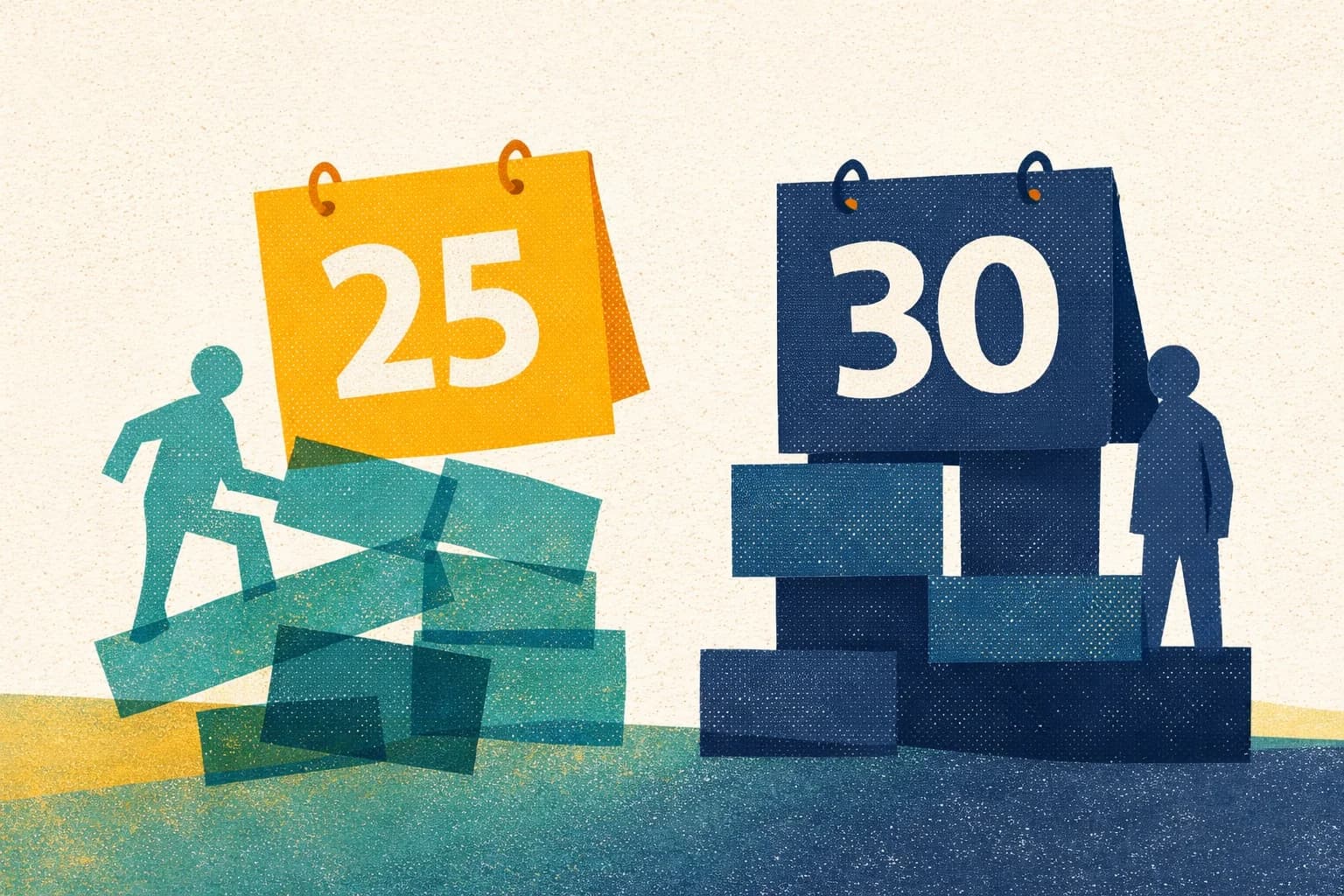
“Buy term insurance as early as possible” is one of the most repeated pieces of financial advice in India. And on the surface, it makes sense: premiums are lowest in your 20s, so locking in early saves money. But there is a less obvious side to this argument. At 25, most people have no dependents, no home loan, and no major financial obligations. Buying a large term insurance policy at this stage means paying premiums for coverage you may not need yet.
This article is not arguing against early purchases. It is arguing for smarter timing. Sometimes, waiting until 30 gives you better-aligned coverage and a more cost-effective policy overall.
98.32%
Industry claim settlement ratio (by count)
FY 2024-25
—Stable: 98.36% in FY 2023-24
₹33,697 cr
Individual death claims paid
FY 2024-25
▲Up from ₹28,868 cr in FY 2023-24
Cheat Sheet
•
Premiums at 30 are still affordable: The difference between age 25 and 30 is roughly ₹1,500-2,500 per year for ₹1 crore cover.
•
Coverage alignment: At 30, you have real financial responsibilities that justify the cover amount.
•
5 years of wasted premiums: If you have no dependents at 25, those early premiums protect nobody.
•
Health is the wild card: If you have a family history of health issues, buying at 25 before any conditions develop may be the smarter move.
The Premium Difference: 25 vs 30
The most common argument for buying at 25 is the premium advantage. Let us look at what that advantage actually means in rupee terms.
| Age at Purchase | Annual Premium (₹1 Cr, 30-year term) | Total Premiums Paid Over Policy Life | Cover Ends At Age |
|---|---|---|---|
| 25 | ₹6,000-7,000 | ₹1.80-2.10 lakh (30 years) | 55 |
| 30 | ₹7,500-9,000 | ₹2.25-2.70 lakh (30 years) | 60 |
| 35 | ₹11,000-13,000 | ₹3.30-3.90 lakh (30 years) | 65 |
| 40 | ₹17,000-20,000 | ₹5.10-6.00 lakh (30 years) | 70 |
Note: These are indicative ranges for a healthy, non-smoking male. Actual premiums vary by insurer and medical history.
The difference between buying at 25 vs 30 is roughly ₹1,500-2,000 per year, or about ₹45,000-60,000 over the entire policy life. That is a modest amount. The real premium jump happens after 35, when rates nearly double.
The Coverage Alignment Problem
Term insurance exists for one purpose: to replace your financial contribution if you die. At 25, ask yourself these questions:
- Do you have dependents who rely on your income?
- Do you have a home loan or significant debt?
- Would anyone face financial hardship if you were gone?
For most 25-year-olds, the answer to all three is no. You might be single, living with parents, and your biggest financial obligation is a phone EMI. In this situation, a ₹1 crore term insurance policy is protecting against a risk that does not yet exist.
By 30, the picture typically changes. You might have a spouse, a child on the way, a home loan of ₹40-60 lakh, and parents who depend on your support. Now the ₹1 crore policy has a clear purpose: it replaces your income so your family can pay the EMI, raise the children, and maintain their lifestyle.
₹
33,697 Cr
paid out as individual death claims by the life insurance industry in 2024-25 — across 10.12 lakh settled policies. These are real families collecting real money because someone bought a policy at the right time.
Source: IRDAI Handbook 2024-25, Individual Death Claims — Industry Aggregate
The Opportunity Cost of Early Premiums
If you buy at 25 with no dependents, those first 5 years of premiums are essentially wasted. Here is what that money could do instead:
- ₹6,000-7,000/year invested in an index fund (assuming 12% average return) would grow to roughly ₹41,000-44,500 by age 30. Not life-changing, but it compounds further over decades.
- Emergency fund: Those premiums could go toward building your emergency fund, which arguably matters more at 25 than a death benefit nobody would claim.
- Health insurance: If you do not already have a personal health insurance policy, that money is better spent on a ₹5-10 lakh health cover, which protects you (not a nominee) against a much more likely event.
When Buying at 25 IS the Right Call
This article is not saying “never buy at 25.” There are clear scenarios where early purchase makes sense:
- Family history of health issues: If diabetes, heart disease, or cancer runs in your family, buying at 25 before any conditions develop locks in standard (non-loaded) premiums. A diagnosis at 28 could mean significantly higher premiums or even rejection at 30.
- You already have dependents: If you are supporting parents or have taken an education loan that would fall on family members, you already have a financial obligation to protect.
- You have significant debt: A car loan, education loan, or any debt that would pass to family members justifies early cover.
- You are a smoker or have a risky occupation: Premiums for smokers and hazardous occupations are already loaded. They will only increase with age, making early purchase more beneficial.
The “Sweet Spot” Strategy
If you are healthy at 25 with no dependents, consider a middle-ground approach:
- Buy a small base policy at 25: A ₹25-50 lakh policy costs ₹2,000-3,500 per year. This locks in insurability (proof of health) and gives you a base layer of coverage.
- Top up at 30 when responsibilities arrive: Add a second policy of ₹75 lakh to ₹1 crore when you have a home loan, spouse, or children. Your total cover now matches your actual obligations.
This staggered approach costs slightly more in total premiums than a single policy at 25, but it means you are never paying for unnecessary coverage, and your cover amount grows as your responsibilities grow.
Case Study: Ankit vs Rahul
Ankit, 25: Single, no loans, lives with parents. Buys ₹1 crore term insurance at ₹6,500/year. For the next 5 years, he pays ₹32,500 in premiums. Nobody depends on his income during this period. If something happened to him, his parents would grieve but not face financial hardship (they have their own retirement savings).
Rahul, 25: Same profile. Invests ₹6,500/year in a liquid mutual fund instead. At 30, he gets married, buys a flat with a ₹50 lakh home loan, and is expecting a child. He now buys ₹1 crore term insurance at ₹8,500/year. His cover is perfectly aligned with his actual financial exposure. His 5 years of invested premiums have grown to ~₹42,000, which he adds to his emergency fund.
Rahul pays about ₹60,000 more over the total policy life. But for 5 years, every rupee of his premium protected real financial dependents. Ankit paid for 5 years of coverage that protected nobody.
FAQs
Is it cheaper to buy term insurance at 25?
Yes, annual premiums are about ₹1,500-2,000 lower at 25 compared to 30 for the same cover amount. However, you also pay premiums for 5 extra years, and if you have no dependents during that time, those payments protect nobody.
What is the best age to buy term insurance?
The best age is when you first have someone who depends on your income. For most people, this is between 27-32, when they get married, take a home loan, or start a family. If you have dependents at 22, buy at 22. If you are single with no obligations at 28, there is no urgency.
Can I increase my cover later if I buy a small policy at 25?
Yes. You can buy a second (or third) term insurance policy at any age, subject to fresh medical underwriting. Many people hold multiple policies with different cover amounts purchased at different life stages.
What if I develop a health condition between 25 and 30?
This is the biggest risk of waiting. If you are diagnosed with diabetes, hypertension, or any chronic condition, your premiums at 30 could be 50-100% higher, or you might face exclusions. If your family has a history of early-onset health conditions, buying at 25 is the safer choice.
Should I buy at 25 just because premiums are cheap?
Low premiums alone are not a reason to buy. Term insurance is a financial tool, not a bargain deal. Buy it when the purpose (protecting dependents from income loss) actually applies to your life. If it does not apply yet, invest that money instead and buy when it does.
Buy When the Need Is Real
The “buy as early as possible” advice is not wrong; it is just incomplete. Buying at 25 makes sense if you have dependents, significant debt, or health concerns that could worsen. But if you are healthy, single, and debt-free, waiting until 28-30 means your coverage aligns with real financial responsibilities, and you are not paying for protection nobody needs. The premium difference between 25 and 30 is modest. The coverage alignment difference is significant.
Related Reading
Try our free tools
Disclaimer: This article is for informational purposes only and does not constitute insurance advice. Consult an IRDAI-registered insurance advisor for recommendations tailored to your specific financial situation and needs.
Was this article helpful?
Your feedback helps us improve our guides

Reviewed and Edited by
Manan ShahManan Shah is a finance and economics writer with experience in research and analysis. His work centers on investments and personal finance, where he translates complex ideas into clear, practical insights for everyday readers. He has written extensively on mutual funds, market trends, and financial planning, with a strong focus on accuracy, clarity, and reader relevance.