
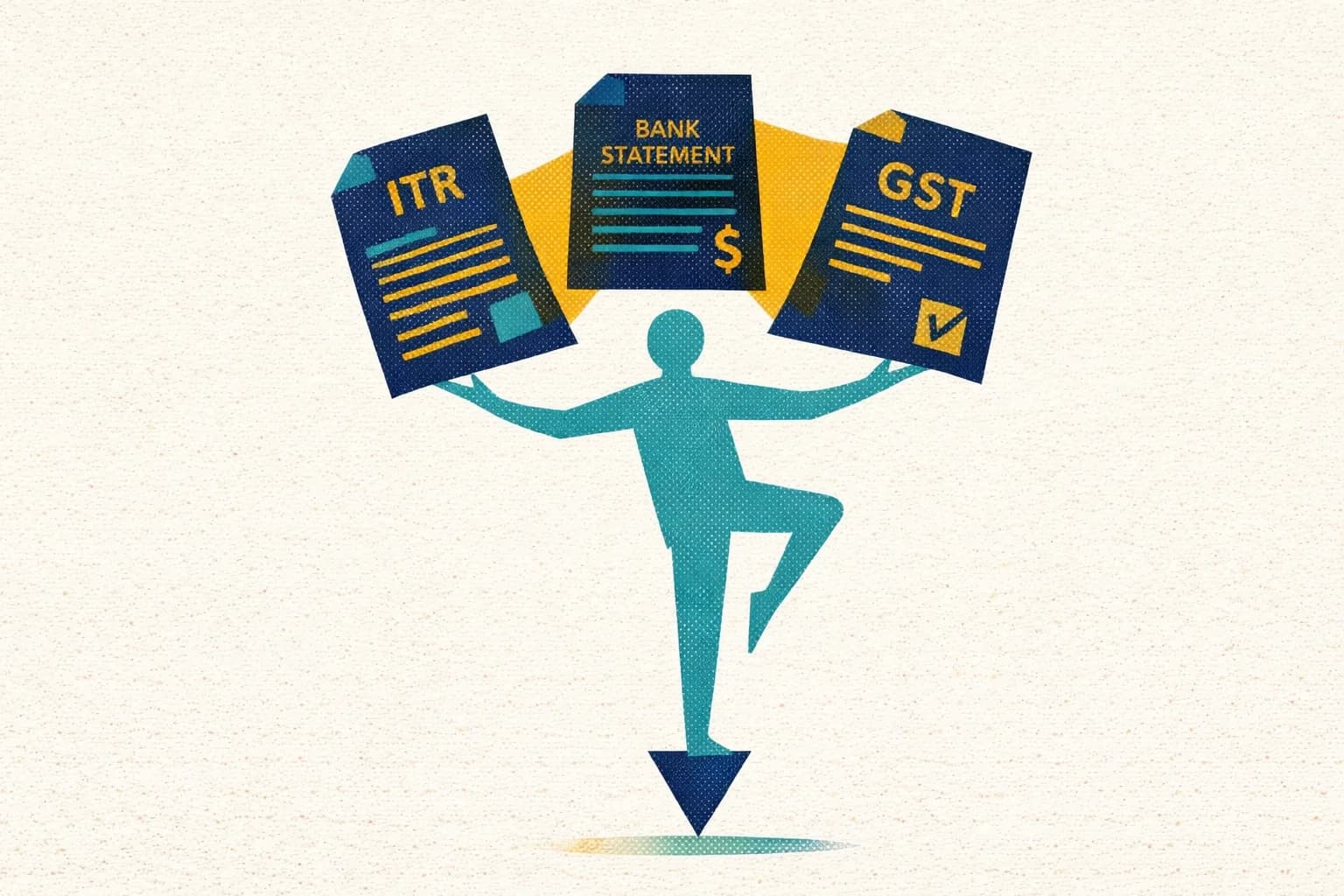
Buying term insurance as a salaried employee is straightforward: show your Form-16, salary slips, and you are done. For freelancers, the process is entirely different. Insurers do not know how much you earn, how stable your income is, or whether you can sustain premium payments for 20-30 years.
That is where your financial documents come in. ITRs, bank statements, and GST returns are not just tax formalities; they are the tools that determine whether you get approved, how much coverage you qualify for, and what premium you pay. Get them right, and you can secure coverage comparable to any salaried professional. Get them wrong, and you may find yourself underinsured or paying more than you should.
Cheat Sheet
•
Freelancers need ITRs, bank statements, and GST returns (if applicable) to prove income stability to insurers
•
2-3 years of ITRs is the most important document; it determines your maximum sum assured
•
Bank statements show actual cash flow; irregular or cash-heavy transactions raise red flags
•
GST registration (even if voluntary) adds credibility and can help justify higher coverage
•
Weak documentation leads to lower approved cover, higher premiums, and potential claim disputes later
•
Consistent, clean financial records are your strongest tool for getting the right coverage at a fair price
Why Insurers Treat Freelancers Differently
For salaried employees, income verification is simple: the employer issues Form-16 and salary slips. The income is predictable, and the risk of premium default is low.
Freelancers present a different risk profile:
- Income is variable: You might earn Rs 3 lakh one month and Rs 50,000 the next
- No employer guarantee: There is no company vouching for your income or providing group insurance
- Documentation is self-reported: Insurers rely on your filed tax returns and banking records, which they need to verify independently
This does not mean freelancers cannot get good coverage. It means you need to make your financial trail as clear and convincing as possible.
98.32%
Industry claim settlement ratio (by count)
FY 2024-25
—Stable at 98%+ since FY 2017-18
17,333
Individual death claims repudiated
FY 2024-25
▲Up from 16,408 in FY 2023-24
The Three Documents That Matter
1. Income Tax Returns (ITRs): Your Foundation
ITRs are the single most important document for a freelancer’s term insurance application. Insurers use your declared income to calculate the maximum sum assured they will approve, typically 10-20x your annual declared income.
Key Fact
Insurers calculate your maximum sum assured at 10-20x your declared annual income — not gross revenue, but net income after business expenses. A declared income of ₹8 lakh could qualify you for ₹80 lakh to ₹1.5 crore in coverage.
What insurers look for:
- Consistent income across 2-3 years (growing or stable is ideal)
- Income after business expenses (net income, not gross revenue)
- CA-certified computation of income for higher credibility
- The ITR form used (ITR-3 for professionals, ITR-4 for presumptive taxation)
Common mistakes:
- Under-declaring income to save tax, then expecting insurers to approve cover based on actual (higher) income
- Filing ITR only for the current year; insurers want 2-3 years of history
- Not attaching the computation sheet or balance sheet
The rule of thumb: Your ITR-declared income directly determines your maximum approved sum assured. If you declare Rs 8 lakh annually, expect a maximum cover of Rs 80 lakh to Rs 1.5 crore (depending on the insurer’s multiple).
2. Bank Statements: The Cash Flow Evidence
While ITRs show what you declared, bank statements show what actually flows through your accounts. Insurers typically request 6-12 months of statements from your primary business account.
What creates a positive impression:
- Regular client payments appearing as NEFT/IMPS/UPI transfers with identifiable descriptions
- Consistent monthly balances (not zero for most of the month with a spike at month-end)
- Multiple income sources (diversified client base)
- Savings patterns (recurring deposits, SIPs, or transfers to savings accounts)
What raises red flags:
- Large cash deposits with no clear source
- Long periods of zero balance followed by sudden large credits
- Bank statement income that does not match ITR-declared income
- Frequent bounced transactions or overdraft usage
3. GST Returns: Your Business Credibility Badge
GST registration is mandatory if your annual turnover exceeds Rs 20 lakh (Rs 10 lakh in some states). But even if you are below the threshold, voluntary GST registration signals that you run a formal business operation.
Did You Know
Even if your freelance turnover is below ₹20 lakh, registering for GST voluntarily gives insurers a third data point confirming your business is formal — and can tip the scales when your ITR income alone looks borderline.
How GST helps your insurance application:
- Proves business volume through filed returns (GSTR-1 and GSTR-3B)
- Shows client base and invoicing patterns
- Provides a third verification point alongside ITRs and bank statements
- Strengthens your case for higher coverage when ITR income alone might seem borderline
How Documentation Affects Your Coverage and Premium
Industry individual death claims: repudiation trend (FY 2020-21 to FY 2024-25)
| Year ⇅ | Claims repudiated ⇅ | Amount repudiated (₹ crore) ⇅ | CSR by amount ⇅ |
|---|---|---|---|
| FY 2020-21 | 12,559 | 924.70 | 96.62% |
| FY 2021-22 | 16,509 | 1,291.58 | 97.26% |
| FY 2022-23 | 15,173 | 1,049.59 | 96.46% |
| FY 2023-24 | 16,408 | 893.18 | 97.00% |
| FY 2024-25 | 17,333 | 976.45 | 97.18% |
Source: IRDAI Annual Reports, FY 2020-21 through FY 2024-25
| Document Strength | Likely Outcome | Example |
|---|---|---|
| Strong (3-year ITRs + consistent bank statements + GST) | Full requested cover approved at standard premium | Freelancer earning Rs 12L/yr gets Rs 1.5 crore cover |
| Moderate (2-year ITRs + bank statements, no GST) | Partial cover approved, possibly with slight loading | Same freelancer gets Rs 1 crore cover |
| Weak (1-year ITR + irregular bank statements) | Significantly lower cover, higher premium loading | Same freelancer gets only Rs 60 lakh cover |
| No ITR filed | Application may be rejected; if approved, minimal cover | Cover limited to Rs 25-30 lakh maximum |
Case Study: Two Freelancers, Same Income, Different Outcomes
Rohan (well-documented): Freelance web developer, 31 years old. Annual income: Rs 12 lakh. He has filed ITR-3 for the last 3 years with CA-certified computation sheets. His bank statements show regular monthly payments from 4-5 clients via NEFT. He is GST-registered with quarterly returns filed.
Result: Approved for Rs 1.5 crore term insurance at standard rates. Annual premium: Rs 10,500.
Neha (poorly documented): Freelance graphic designer, 30 years old. Annual income: also Rs 12 lakh. But she has filed ITR for only 1 year, declared only Rs 6 lakh (to reduce tax liability). Her bank statements show irregular deposits, some in cash. No GST registration.
Result: Approved for only Rs 60 lakh cover. Premium loaded by 10% due to perceived risk. Annual premium: Rs 6,900 for less than half the coverage Rohan got.
The income was the same. The documentation made all the difference.
Watch Out
Declaring a lower income to reduce your tax liability is a common freelancer move — but it directly caps the coverage you can qualify for, and you cannot claim a higher sum assured based on income you never officially declared.
Step-by-Step: Preparing Your Documents for a Term Insurance Application
- Step 1: File your ITR for the last 2-3 years. If you have been under-declaring, file a revised return or wait until next year’s filing shows your actual income.
- Step 2: Get a CA to certify your income computation. This adds significant credibility.
- Step 3: Use a dedicated business bank account for all client payments. Avoid mixing personal and business transactions.
- Step 4: Register for GST if your turnover exceeds the threshold, or consider voluntary registration for credibility.
- Step 5: Reconcile your ITR income with bank statement inflows. Significant mismatches will be questioned.
- Step 6: Apply for term insurance with all documents ready. Delays in document submission slow down underwriting.
Insurer Requirements at a Glance
| Document | Period Required | Purpose | Impact on Application |
|---|---|---|---|
| ITR with computation sheet | 2-3 years | Declared income, basis for sum assured | Most critical; determines max cover |
| Bank statements | 6-12 months | Cash flow consistency, income verification | Supports ITR claims; flags discrepancies |
| GST returns (GSTR-1, GSTR-3B) | Annual, if registered | Business volume, client base | Adds credibility; helps justify higher cover |
| CA certificate | Current year | Third-party income verification | Strengthens application significantly |
| Business registration (if any) | Current | Proof of formal business entity | Optional but helpful |
What About Claim Time?
Documentation is not just an application-stage formality. At claim time, if the insurer finds that your declared income at application was significantly inflated compared to actual income (based on post-mortem financial investigation), they can challenge the sum assured on grounds of “moral hazard” or “over-insurance.”
₹
976 crore
Total value of repudiated individual death claims across the life insurance industry in FY 2024-25. Mismatched or inflated documentation is one of the reasons insurers reject claims.
IRDAI DATASource: IRDAI Annual Report 2024-25
Watch Out
If a post-claim investigation finds your declared income was inflated, the insurer can dispute the payout on over-insurance grounds — leaving your family to fight a claim battle at the worst possible time.
This is rare, but it happens when:
- The sum assured is disproportionately high relative to verifiable income
- Multiple policies were taken from different insurers with inflated income proofs
- Income documentation was falsified or manipulated
The solution is simple: be honest in your application, and ensure your documents accurately reflect your income. What you declare today affects what your family receives tomorrow.
FAQs
Can I buy term insurance without filing ITR?
Some insurers offer term plans without ITR for lower coverage amounts (typically up to Rs 25-30 lakh). However, the premium may be higher, and the coverage limit is restrictive. For any meaningful coverage (Rs 50 lakh+), ITRs are practically mandatory.
Which ITR form should freelancers use?
Most freelancers file ITR-3 (for income from business or profession) or ITR-4 (under the presumptive taxation scheme if gross receipts are within limits). Your CA can advise on the right form based on your income structure and deduction claims.
Will my premium be higher because I am a freelancer?
Not directly. Term insurance premiums are based on age, health, smoking status, and sum assured, not on employment type. However, if your documentation is weak and the insurer applies a premium loading due to perceived income risk, you effectively end up paying more. Strong documentation eliminates this issue.
I earn in foreign currency from international clients. Does that help?
Yes, as long as the income is reflected in your ITR and bank statements. International client payments that show up as regular SWIFT or PayPal transfers in your bank account actually strengthen your application because they demonstrate a diversified, stable income source.
What if my income dropped significantly in one year?
One bad year out of three is usually not a deal-breaker. Insurers look at the average across 2-3 years. If two out of three years show strong income, the application is likely to be assessed on the average. However, if the most recent year shows a steep decline, the insurer may use the lower figure or ask for additional explanation.
Should I apply for term insurance before or after my ITR filing season?
Apply after you have filed and received acknowledgement for your most recent ITR. This gives the insurer the most current income data. Applying between July (filing deadline) and December is ideal, as you will have the freshest documentation available.
Quick Tip
Always apply for term insurance after your ITR acknowledgement is in hand, not before. Fresh documentation means the underwriter is assessing your actual current income, not last year’s stale figures.
Try our free tools
Disclaimer: This article is for informational purposes only and does not constitute insurance advice. Consult an IRDAI-registered insurance advisor for recommendations tailored to your specific financial situation and needs.
Was this article helpful?
Your feedback helps us improve our guides

Reviewed and Edited by
Girish KumarGirish Kumar is a YouTube Manager at Quantent, focused on building digital growth through thoughtful strategy, strong client collaboration, and content that performs. He works across marketing, design, and digital systems to turn complex business needs into clear, actionable solutions. At Quantent, Girish partners closely with brands to streamline service delivery, improve conversions, and create long term value balancing creativity with structure, and always prioritizing quality over quantity.